by Tyrell | Jul 14, 2022 | News, Storage
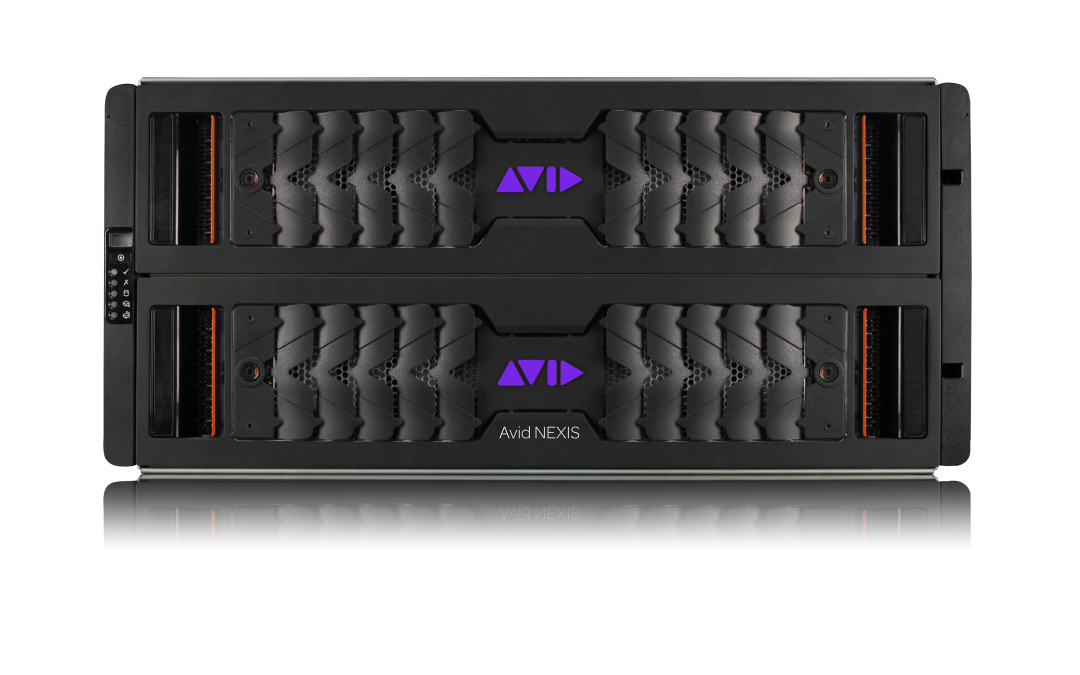
This week sees Avid announcing the latest in its NEXIS product range and for those that have lived the Unity to ISIS, ISIS to NEXIS transitions you’ll be pleased to hear that the NEXIS F-Series addition is an evolution not a revolution to the product line.
A graceful, transparent addition rather than a heavily caveated qualification nightmare.
Why have Avid introduced the NEXIS F-Series now?
Simply, the world as we know it is going through manufacturing challenges and Avid are not immune to these. So, they have cleverly taken the opportunity to introduce some improvements they have been wanting to do for some time while moving to the new Seagate chassis.
These include increased:
- User and file count
- Chassis bandwidth and NIC performance improvements (600MB/S) and NIC performance improvements (10/25GbE for F2 and 25/50Gbe for F5)
- NEXIS file system subscription
The first thing all NEXIS Pro and NEXIS E-Series users will be worried about is the compatibility with their existing infrastructure. This is where we support our comment above about it being a transparent addition. The NEXIS F-Series chassis can be seamlessly integrated into an E-Series setup.
However, there are a couple of caveats to be aware of are:
- Controllers in F-Series are different to that in the E-Series. This only affects those facilities that hold spares.
- Speeds in an E-Series and F-Series system will be limited to the 400Mb/s of the E-Series. You will need to separate the F-Series chassis as its own storage group if you want to take advantage of the bandwidth improvements.
- If you add an SDA+ to benefit from higher file count then a migration of the data set is required.
What else do you need to know?
- NEXIS Pro is replaced with the NEXIS Pro+
- NEXIS E2 is replaced with the F2
- NEXIS E4 is replaced with the F2 and an expansion chassis called F2X
- NEXIS E5 is replaced with the F5
- NEXIS E5NL replaced with the F5NL
- NEXIS SDA is replaced with the SDA+
One last thing to note is the NEXIS E-Series is no longer available but the NEXIS F-Series is shipping now.
Want to know more about Avid NEXIS Subscription or Avid NEXIS F-Series or place an order?
Contact us on sales@tyrellcct.com, 0207 148 6200 or +353 (1) 888 1118.

by Tyrell | Jul 6, 2022 | Cloud, News
Tyrell’s very own Dan Muchmore and Nick Soper sat down with the KitPlus TV Team to discuss the newly released Tyrell Cloud Platform.
Tyrell Cloud simplifies the migration to the cloud for production workflows. It redefines system integration by automating the deployment service of all AWS infrastructure and manufacturer services. Meaning our customers don’t have to. Tyrell Cloud is also a fully managed production service giving our customers complete control over when their cloud infrastructure runs, resulting in ultimate control of their costs.
Want to know more about Tyrell Cloud?
Contact us on sales@tyrellcct.com, 0207 148 6200 or +353 (1) 888 1118.

by Tyrell | Jun 23, 2022 | Audio & Intercom, News

Clear-Com has recently announced the integration of HelixNet Digital Partyline with the Arcadia Central Station. This important integration unites two innovative product lines into one intelligent communication system.
Arcadia now boasts support for over 100 beltpacks and 180 ports of mixing all powered from a 1RU rack. Arcadia is now positioned to support the largest of systems as it can fully support up to:
- 64 HelixNet endpoints – including HelixNet Remote Stations, Speaker Stations, and Beltpacks including over 24 HelixNet-enabled channels.
- 40 FreeSpeak Belt Packs and 16 AES67 Transceivers/10 Original FreeSpeak Transceivers.
- 64 Channels of DANTE
- 4-wire and 2-wire interfacing.
“This is a great update to the Clear-Com product line,” commented Sales Director Dan Muchmore. “We’ve been waiting for this moment for years and it’s finally arrived. The best-in-class wireless and wired technology have been brought together on a single platform. We cannot wait to see our customers take advantage of this integration but most importantly what comes next from Clear-Com for the Arcadia product line”.
We are expecting Arcadia Central Station with HelixNet integration to start shipping this Summer.

Want to know more or place an order?
Contact us on sales@tyrellcct.com, 0207 148 6201 or +353 (1) 888 1118.

by Tyrell | Sep 28, 2021 | Cloud, News, tyrell's take
Cloud adoption is a very emotive and often a confusing set of topics. For a risk averse community such as production, taking the first step into the cloud is undoubtedly pulse raising. Factors such as cost control immediately spring to mind, as well as risking client relationships and the liability for assets that aren’t necessarily your own. Considering we are used to very predictable timetables and airtight outcomes for deliverables using on-premises solutions. Why add more stress, and risk budget overspend by going into the cloud?
Well, not wishing to boil the ocean with a single sweeping statement or approach, cloud when introduced cautiously and carefully, can greatly increase productivity and throughput at various stages of the average production workflow. For example, restrictions for content ingest from set are usually tied to the horsepower of the one or two computers we have in our racks to process rushes into an offline edit ready state. Yet, when applying the infinite horizontal scale of parallel compute available in the cloud, ingest processing can be hugely accelerated.
As many of us already appreciate the dreaded cloud egress pretty much always features when trying to devise a workflow modification in production using cloud. Ingressing bulk rushes content from a shoot into the cloud is free. The cost comes when egressing the relevant files the edit needs back to ground. But one must consider the benefits of the cloud when we are not reliant on just the one or two machines being available for rushes ingest. Potentially ten’s if not hundreds can add a game changing effect to your production’s labour budgets and turn-around times.
For example, egressing 1 hour of DNx36 1080p25 proxy (~16GB) can cost as little as £1.75. This may sound high when you counter that with, “I’ve already got machines that can do this overnight”. But when you throw infinite compute breadth at your rushes processing, as well as then intelligently and automatically transferring them to your nearline or even online storage ready for a Dailies assembly to start, your project lead times can really be reduced.
Also stepping backwards up the workflow pipeline, the cloud can assist with the offload from set without having to rely on the usual transport drive overhead. Content is invariably written to disk directly on set. So, if the upload to cloud ingest processing is directly configured on this set storage, then a download of rapidly produced offline proxies can occur automatically. Mitigating the whole transport drive wrangling process, purchase, and even potential loss. Plus, an added benefit is that all content stored in the cloud is underpinned by SLAs more watertight than your own on-premises equipment.
Another fringe benefit may be to create a production specific archive on the most applicable type of storage for the duration of the project. This can avoid the cost centre of investing in an on-premise archive strategy using technologies such as LTO, which also dictates its own labour and engineering overhead.
As mentioned at the start of this blog, there are many topics that can be touched when considering a move to cloud. Major take-aways from this would be that any cloud resource usage can easily be aligned to productions. The previous examples have focused on how technology can accelerate stages of the workflow. Another reason that cloud is the future for production companies is that it aligns itself with the economic fluctuations that a production company faces when managing the business between commissions.
The traditional CapEx model requires you to build infrastructure to suit a project’s requirement. How does this model align to the business when its quiet or when you need to expand? The ultimate argument for cloud production is that it allows you to take advantage of the expansion and contraction. Expand your production architecture when the commission requires it and contract in the fallow period. With technology such as Teradici and SRT streaming from Haivision, an editor will have no idea that they are working on a virtual cloud environment. So, align your tech to an OpEx model.
By using simple techniques in AWS such as Cost Allocation Tagging, deployment of cloud infrastructure being conducted with fully orchestrated platforms such as Tyrell Cloud can greatly assure you of success. As all cloud consumption billing and costs incurred can be reconciled against a particular production, again further advancing towards OpEx.

Nick Soper, Tyrell Cloud Platform Owner
[/av_textblock]
by Tyrell | Aug 3, 2021 | Cloud, News, tyrell's take
We all know workflows in M&E can be challenging. Especially considering aspects such as project shooting ratios and the necessity of rapid content ingest to cope with project deadlines. These can be compounded further with other factors including new acquisition and deliverable formats, as well as the geographies that many projects straddle. Bringing tremendous pressures to a business.
Often the simplest route has been a capital purchase of on-premise hardware solely to achieve a project requirement. This not only increases the project’s cost base but also increases engineering resources, potentially reducing margins. Once these new on-premises solutions have been implemented, an increase in planning and resource management is required as an on-going overhead to the business. There is an alternative economic and technical model for M&E and that is the public cloud.
The cloud can help address this constant project resource allocation battle vs profitability. One of the major benefits of using public cloud is the massive economies of scale. Cloud providers invest vast sums in infrastructure, storage and compute. By letting them take the strain of high-cost CAPEX infrastructure investment means these economies of scale can be applied to an organisation’s own infrastructure demands and allow granular accounting and technical planning at a project level.
Beyond the tremendous efficiencies and cost savings of cloud computing, there is another economic benefit; business agility. Businesses can utilise cloud computing resources to deploy workflows faster and ramp up storage and computing power on demand. This I.T. agility allows businesses to respond quickly to market and project changes as well as customer demands. Leading to more efficient working and faster routes to revenue.
There is an obvious and warranted concern over run-away costs when considering the leap to the cloud. Businesses should analyse the economic pros and cons to get a detailed picture of costs and savings and ask whether it will lead to long-term savings and efficiencies. This type of question is often difficult to answer and will differ depending on the organisation’s needs and circumstances, as well the cloud solution that is being considered. The goal is to avoid a cloud adoption strategy that drives up cost, complexity and staffing resources.
Testing the waters with a smaller piece of the workflow puzzle is a good way to run an analysis to help identify and rationalise these costs. Migrating a component such as an integral file transfer facility to a cloud hosted infrastructure may seem illogical, even with the ominous cloud egress data charges, but on-going running costs can decrease. Service uptime is also significantly increased, as there is a separation from the underlying infrastructure that you’re no longer responsible for.
Fringe benefits such as massive cloud backbone network bandwidth can further enable decreased project processing times. Gone are the bottlenecks of an on-premise ISP connection which is often saturated during day-to-day operations. Locating a core capability on the public cloud can lead to many more efficiencies with downstream workflows being more easily constructed for specific projects or more of a company wide technical standardisation.
Another migration opportunity to consider is locating backup, DR or archive to the cloud. If carefully planned with a well-managed process, infrastructure costs and management overhead can be greatly reduced. Cloud egress or Data Transfer Out (DTO) is a very hot topic in the industry right now. Migration to cloud storage does require analysis to fully understand the operational and technical use cases. Each will require clearly defined success and failure criteria, so that any implemented workflows won’t prevent the business from moving forward. Designing processes and workflows can be factored and optimised so when DTO is required the capacity of data transferred out is greatly reduced.
The last 20 months have shown us that we constantly need to re-evaluate the agility of our businesses. Our economic and technical strategies will be affected by how well we adapt to the rapid changes that are taking place in the industry. The cloud presents us with amazing potential and although cloud adoption and migration of key workflows is a progressive one, the rewards are clearly visible.
Nick Soper, Tyrell Cloud Platform Owner
by Tyrell | Jul 21, 2021 | Audio & Intercom, News
Clear-Com Releases Arcadia Central Station
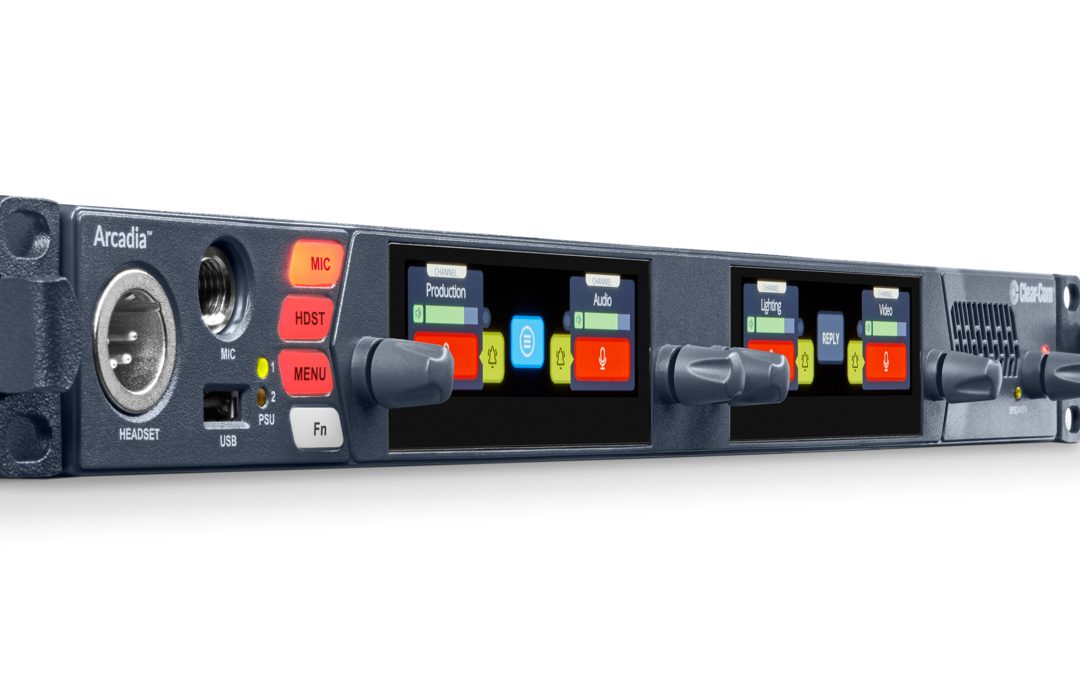
Arcadia is the second significant hardware release from Clear-Com in a matter of weeks. Clear-Com do not release as often as we’d like but when they do, they do it really well. Arcadia looks like the FreeSpeakEdge Base Station that was launched a few weeks ago but this is a very different beast. So much so Clear-Com are deliberately going out of their way to label it as a ‘Central Station System’ and even have it sitting in its own product category on their website. It’s not just wired comms, it’s not just wireless comms. This is all encompassing.
What’s different about Arcadia? It’s a scalable IP platform for the next generation intercom/talkback installations.
Gone are the days where you purchase an intercom solution at its maximum capability. Arcadia is an evolution towards license-based features and I/O, which is available in banks of 16 ports license.
Incredibly it supports all generations of FreeSpeak (1.9 GHz (E1 & IP AES67 Transceivers), 2.4 GHz (E1 Transceiver) & the latest 5 GHz (IP AES57 Transceiver). This is amazing for existing users of FreeSpeak.
Other features include:
- 32 Belt Packs Supported
- 16 AES67 IP Transceivers Supported
- 10 E1 Transceivers
- Its I/O dense. Arcadia boasts up to 96 licenses ports and can be used as a master station itself.
- 64 DANTE ports
- 8 4-Wire ports
- 4 2-Wire ports
- HelixNet Integration in 2022.
- It has beautiful touch screens!
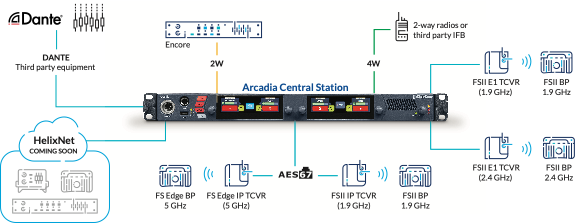
From a Tyrell perspective, we see Arcadia sitting in between a Clear-Com FreeSpeak Edge/HelixNet and an Eclipse matrix system. Arcadia is going to be perfect for theatre as it supports the traditional I/O of 2-Wire and FreeSpeak whilst facilitating a migration towards adding HelixNet IP Partyline and Dante. We also see Arcadia doing well for any Corporate AV and Broadcast installations that require Dante, 4-wire and a large deployment of Wireless users and want to avoid the need to step into the Matrix cost area.
